On April 8, 2024, a total solar eclipse will pass over parts of Mexico, the US, and Canada. I went online to buy a pair of eclipse glasses and read about some products that were not the real deal and wondered how I’d know for sure (the American Astronomical Society has a curated list of suppliers that was updated for the 2024 eclipse). And that’s when I started thinking, “what actually happens if I stare into the sun.” I’ve heard since I was a little kid that “you’ll go blind” if you stare into the Sun too long but never really understood what was happening from a physiological standpoint. So off I went looking for answers.
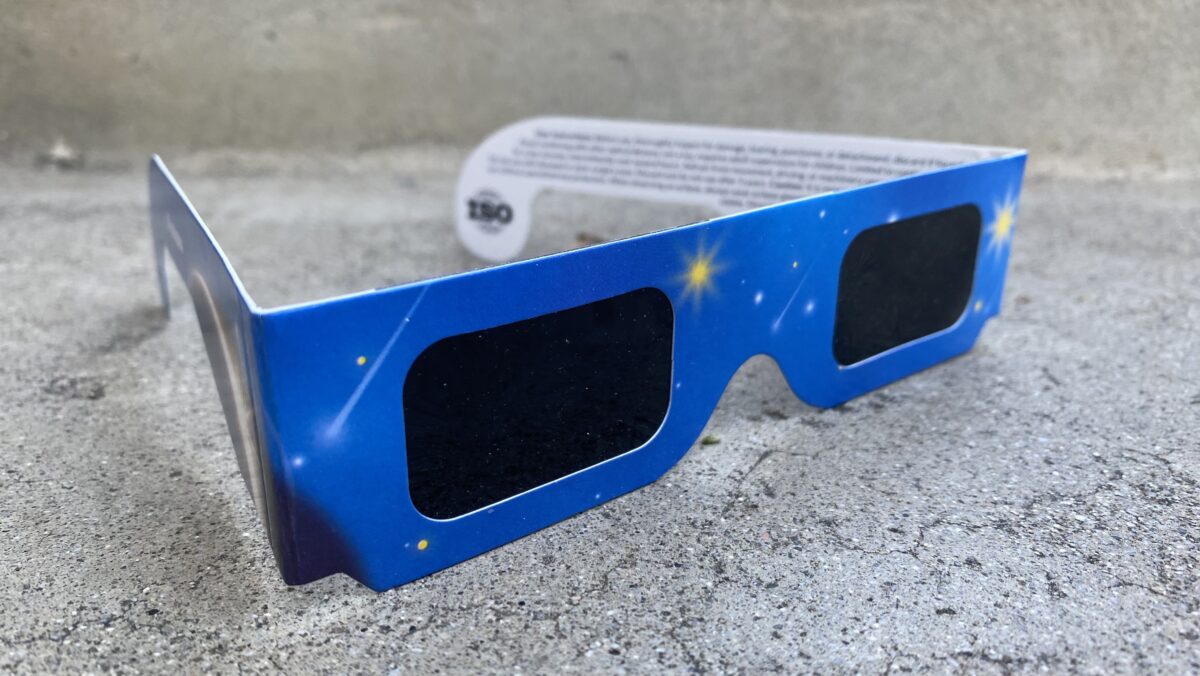
When I started looking into what safety solar eclipse glasses provided, I kept coming across articles that said to look for those that were stamped with an ISO number 12312-2, which is basically a standard for eye protection filters that allow for direct observation of the sun. The standard has transmittance requirements for the filters, meaning how much light is allowed to pass through. This applied to UVA, infrared, and visible light. For ISO 12312-2, these filters can only allow 0.0032% of visible light, which is not much. Put them on and it’s like a welding mask (pretty much pitch black). I tested out the pair I had purchased by looking directly at the sun and it looked like a tiny orange dot.
I was also curious about how these filters are made. There weren’t many articles on the subject and every description seemed to say something similar: a polymer infused with black carbon and a metal backing substrate, usually aluminum. The black carbon absorbs the light and the metal reflect back some additional light. What makes it through the filter to your eye (and it’s not much) is why you’re able to stare at the Sun and not get injured.
So what happens to the eye when you’re not wearing solar eclipse glasses (don’t try this). Again most articles ranged in the amount of detail provided but a couple went deep into the chemistry of what’s occurring when light enters into the eye. Basically, the light hits the macula, an area of the eye on the retina that has a concentration of cones. Because the macula is yellowish in color it absorbs a lot of blue/UV light (if you ever took high-school physics, you probably learned that purple light has the shortest wavelength and the highest level of energy in visible light). In normal conditions when you’re just looking around at your dog chasing a squirrel your body can handle the concentration of light that’s entering the eye. But when you stare directly into the sun, the eye is flooded with too much light. The light is part of a chemical process when (1) Vitamin A (derived from beta-carotene sources like carrots) is converted to (2) 11-cis-Retinal and when (3) exposed to light creates (4) all-trans-Retinal, which after an enzymatic reaction converts back to Vitamin A. But when there’s too much light, the all-trans-Retinal ends ups creating something called free radicals—a lot of them. Normally, cellular metabolism creates free radicals as well and uses them as part of the bodies natural immune system. But at high concentrations, they’re dangerous to cells. Free radicals damage cells by oxidizing cell membranes, lipids, proteins, and all the other good stuff your cells need to operate. Exposure to small amounts of light means this process is reversible but look too long and the damage can be permanent.
Several articles still refer to the injury of staring into the sun during a solar eclipse as a retinal burn but that doesn’t seem to be accurate. While infrared light can cause the inside of the eye to heat up a bit, it’s likely not enough to be the significant cause of the injury. But hey, safety first…the solar eclipse glasses block the infrared light as well.
Bottom line, a quick glance at the sun is not going to blind you or cause any long-term injuries but it will still affect your vision. Sun glasses don’t help. And if you plan on watching the eclipse on Monday make sure you get a pair of solar eclipse glasses that protect your eyes.
Some references I used while researching this question:
- Chemistry explains why you shouldn’t stare at the solar eclipse without protection – https://cen.acs.org/articles/95/i33/Chemistry-explains-shouldnt-stare-solar-eclipse-without-protection.html
- Photo Retinopathy – https://en.wikipedia.org/wiki/Photic_retinopathy#cite_ref-:0_1-0
- Solar Retinopathy – https://eyewiki.aao.org/Solar_Retinopathy
- Macula – https://en.wikipedia.org/wiki/Macula
- Structure of Eclipse Glasses: How are they made? – https://www.microtrace.com/eclipse-glasses-made/
- The science behind solar eclipse glasses – https://www.rochester.edu/newscenter/science-of-solar-eclipse-glasses-safety-598652/
- Are your solar eclipse glasses safe? – https://www.planetary.org/articles/are-your-solar-eclipse-glasses-safe
- Free Radicals, Antioxidants in Disease and Health – https://www.ncbi.nlm.nih.gov/pmc/articles/PMC3614697/#:~:text=When%20produced%20in%20excess%2C%20free,)%20(5%2D10)